From Sidewalks to Construction Zones : How Japan Protects Its Pedestrians
by: Natasya Gracia Filia
The habit of walking, for Japanese people, can be traced back to the Edo period (1600–1800s), when most people lived in small spaces in densely populated cities. Even when the nation has modernized itself, the culture of walking persisted. After the World War II, the government acknowledged the walking tradition by developing dedicated pedestrian paths, introducing comprehensive traffic safety regulations, and building public transit systems that were easily accessible for pedestrians.
Instead of creating a walking culture from scratch, like some modern cities do, the Japanese ensured that the newly built infrastructures fit the already long-standing mobility patterns, thus reinforcing an existing way of living.
Prioritizing Pedestrians
After many decades, the walking lifestyle that is deeply rooted in Japanese people became a main principle in urban planning. This was supported by government policies that are strong and the local culture that is socially disciplined. Japan’s commitment to prioritize pedestrian has been reflected in so many measures such as:
- Weather-resilient sidewalks,
- Perceptible paving for visually impaired citizens,
- Safe and clearly signed crosswalks,
- Well-designed signage,
- Priority zones for pedestrian,
- Seamlessly integrated public transportation, and
- Strict safety standards for roadwork and building construction.
These implementations are strengthened by strict monitoring and enforcement.
The following part is a highlight of key examples of these practices. They demonstrate how a protected and prioritized pedestrian environment can be shaped together from the behaviours of the community, the leadership of the government, and the participation of private-sector.
1. Pedestrian Crossing & Sidewalk
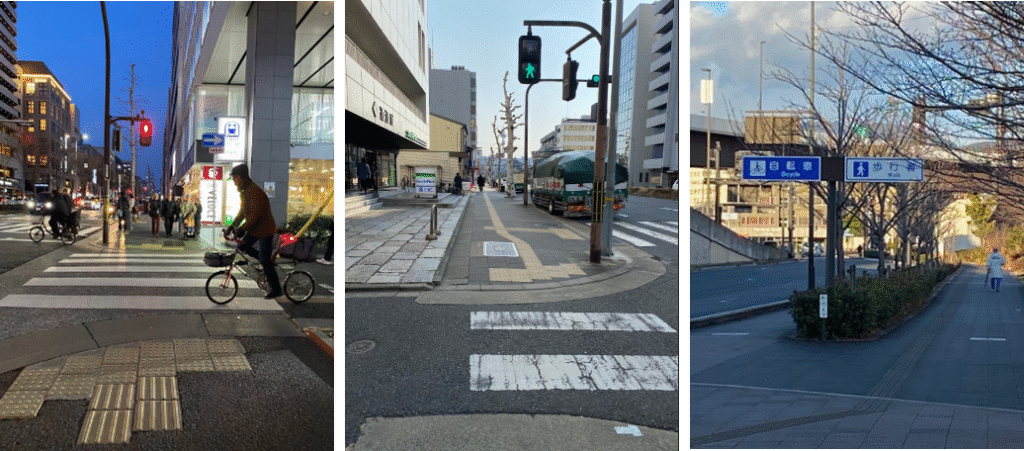
In Japan, pedestrian crossings are designed with clarity, safety, and accessibility in mind. Clear marked zebra crossings and well-timed pedestrian signals are provided not only on arterial roads but down to residential streets. The wide crosswalks were intentional, as they maximize visibility for both pedestrians and vehicle drivers. Pedestrian signals use two colours, red and green, and many are enhanced with unique audible signals to help visually impaired pedestrians as well as countdown timers to hint at remaining crossing time.
Sidewalks also function as shared spaces for both pedestrians and cyclists to maintain smooth mobility for all users. However, in busier urban districts, sidewalks are often divided into dedicated lanes that provide separate paths for pedestrians and cyclists to ensure safer and more predictable movement. Row of trees can sometimes be found lined up along the pedestrian sidewalks to help add shading and pleasant walking environment, particularly during warmer seasons.
2. Road or Sidewalk Construction
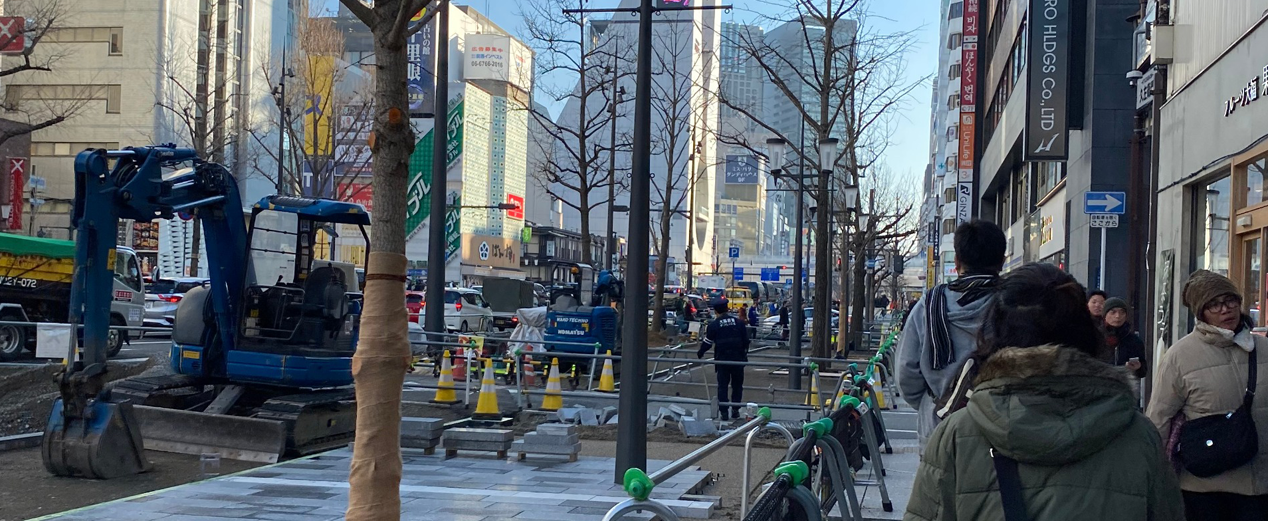
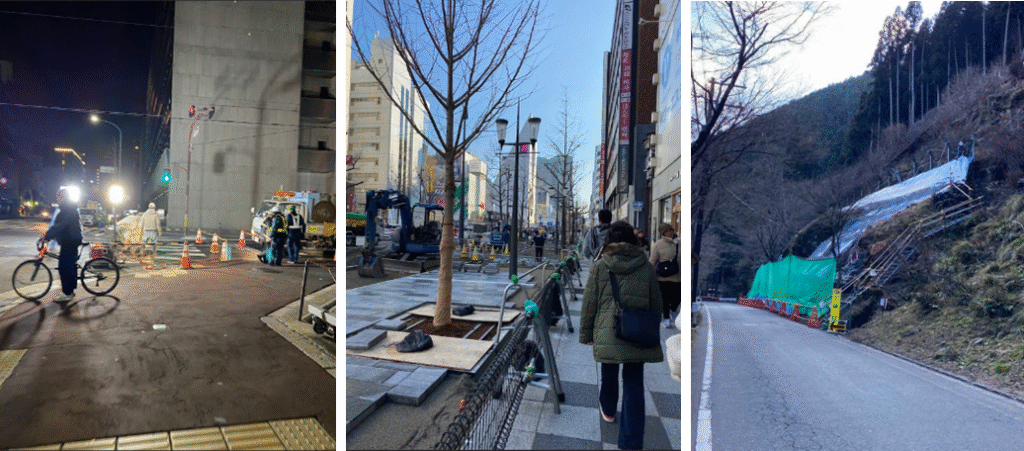
In Japan, construction activities on roads and sidewalks are managed with careful attention to public safety. During construction or repair, authorities consistently provide clear marked barricades, nighttime lighting, and temporary blocks to guide the movement of either pedestrians or vehicles. Work zones are fully enclosed with barriers to prevent public from construction hazard, as well as avoiding unauthorized access. At night, staff are often stationed on-site, equipped with safety gear, to direct pedestrians and motorists, ensuring safe traffic in low-visibility conditions.
Slope stabilization works on roadside – a situation with high risk for passing vehicles– are often equipped with long distance warning signs, traffic cones, barricades, temporary fences, roadway lighting, protective sheds, temporary nets (to hold any rockfall), and temporary rock bolts and soil nailing systems. Scaffolding fitted with safety nets is also installed to prevent falling debris from reaching the roadway. Through this comprehensive approach, such construction work ensures that pedestrians and road users can move through construction zones with safety, confidence, and less disruption.
3. Building Construction
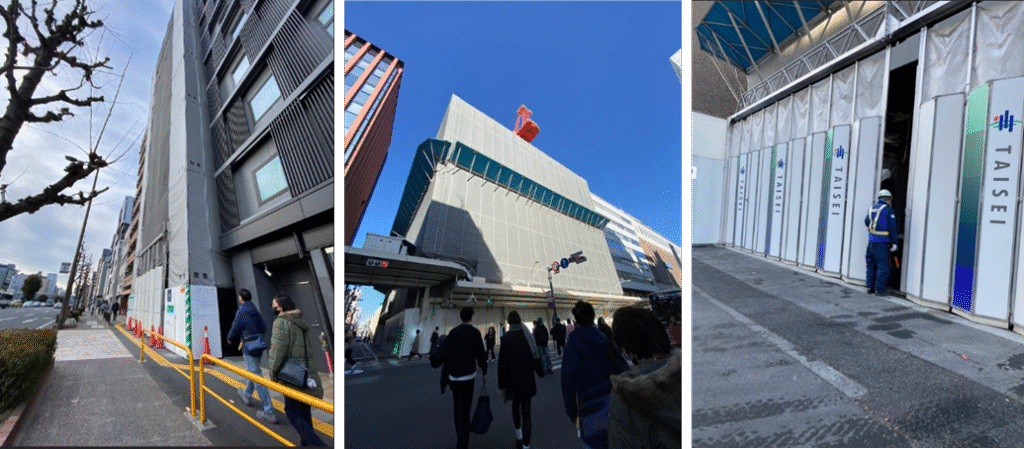
Pedestrian safeguard is prioritized in building construction projects. This is implemented by both private sector and government. Safety measures in areas surrounding the construction zones are designed to maintain safe and uninterrupted pedestrian movement. These include the installation of durable barriers such as steel fences, temporary guiding blocks for visually impaired pedestrians, and full scaffolding systems with safety nets to protect pedestrians from falling objects.
Construction sites are also wrapped with covering sheets to control dust and prevent debris from escaping the work area. Noise-barrier panels are used to reduce construction noise, while clear pedestrian signage is installed to provide guidance for the temporary detours. Covered loading bays are employed so that material handling and unloading activities do not spill out on sidewalks or impede road traffic. Together, these measures demonstrate the commitment to maintaining a safe, predictable, and comfortable environment for pedestrians—even in areas undergoing significant construction activity.
Jakarta in Comparison
From the three examples of implementation discussed above, several elements have begun to appear in Jakarta in recent years. The Jakarta Provincial Government has made efforts to enhance pedestrian infrastructure, including the widening and upgrading of major sidewalks, improving their overall orderliness, and installing tactile paving for the visually impaired. In several locations, dedicated bicycle lanes have also been introduced, separate from pedestrian walkways, to create a safer street environment. Despite the sometimes lack of consistency and poor execution both in the design of sidewalks and bike lanes, it is still a step towards the right direction.
During road or sidewalk repairs, warning signage is now provided, although the consistency remains limited. For works in major infrastructure such as the LRT, safety improvements are increasingly evident, with several sections equipped with safety nets, barricades, and warning signage installed to alert surrounding pedestrians and road users. These measures reflect encouraging progress that also highlight the opportunities for Jakarta to further improve the safety and comfort of its pedestrians.
In essence, Japan’s pedestrian-oriented environment is the product of centuries-long walking culture, strengthened by meticulous urban planning, strict safety standards, and well-coordinated public–private implementation. The country’s commitment to protecting and prioritizing pedestrians—whether in the safety of road crossings, road and building construction, or the seamless integration with public transit—demonstrates how cultural habits, consistent policies, and disciplined execution can shape a highly walkable and safe urban landscape.
While Indonesia’s large cities have begun to adopt some standards for pedestrian infrastructure, Japan’s experience underscores the long-term vision, continuous investment, and cross-sector collaboration required to build walkable, safe, comfortable, and universally embraced cities. There still remains a significant gap in Ministry of Civil Work’s understanding, which currently favors compliance (“box- checking”) over providing comfortable walking experience. Current efforts–such as bicycle lanes that run only on specific road sections and inconsistent tactile paving that can be hazardous for the visually impaired–demonstrate a lack of thoughtfulness. This must be addressed quickly to genuinely provide a much safer pedestrian walkways.